I've had this conversation hundreds of times over 21 years. A seller looks at what their neighbor got, adds a little cushion "just to see," and lists $30,000 — sometimes $50,000 — above where the market actually is. The thinking makes sense on the surface: if someone wants to negotiate me down, at least I've got room to move.
Here's the problem. That's not how buyers think, and it's not how the market works.
The Data Doesn't Lie
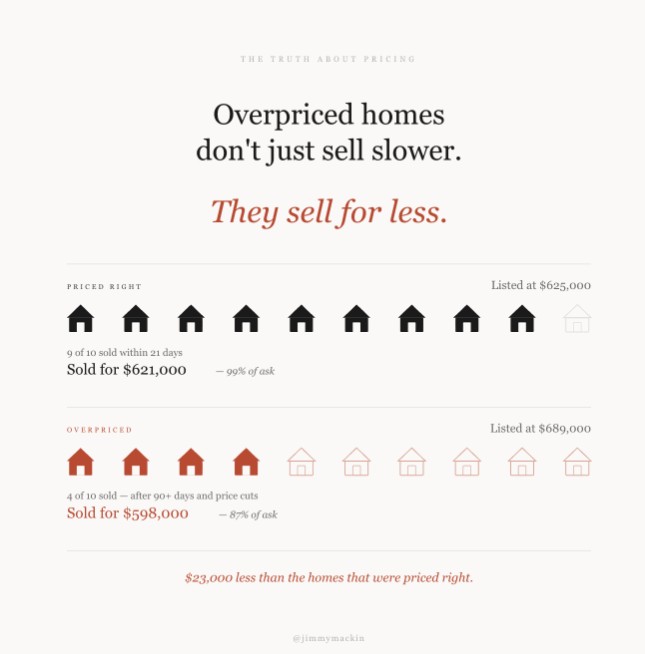
Look at the numbers in the graphic above. Two comparable homes. One priced right at $625,000 — it attracted strong buyer interest, generated competition, and sold for $621,000 in 21 days. That's 99% of asking price. The seller walked away with what they expected.
The other home was listed at $689,000 — overpriced by roughly 10%. What happened? Buyers passed. It sat. Then came the price cuts. Then more waiting. By the time it finally sold, 90+ days had gone by and the final number was $598,000. That's 87% of the original ask — and $23,000 less than the home that was priced correctly from the start.
"Chasing the market down is the most expensive strategy in real estate."
Why Overpricing Backfires
When a home first hits the market, it gets the most attention it will ever get. Buyers who've been watching the Baltimore market know what things are worth — often better than sellers realize, because they're actively comparing every week. An overpriced home gets dismissed immediately. Serious buyers move on. The only people who schedule showings are the ones who are just browsing, not buying.
Then the days on market start to pile up. And in real estate, days on market is a signal. Buyers start to wonder: what's wrong with it? Why hasn't anyone made an offer? That stigma is hard to shake. By the time you reduce the price to where it should have been, the buzz is gone. You're negotiating from a weak position instead of a strong one.
What "Priced Right" Actually Means
It doesn't mean pricing low to create a frenzy — though in the right market, a strategic underlist can generate multiple offers and push you above asking. It means pricing where qualified buyers will immediately recognize the value, schedule showings, and make serious offers. That sweet spot is different for every home, every neighborhood, every season.
In Baltimore, I've seen the same dynamic play out in Canton, Federal Hill, Roland Park, and Towson. The neighborhoods are different. The price points are different. The result of overpricing is always the same.
My Advice Before You List
Before you pick a number, get a real comparative market analysis — not an automated estimate, not a guess based on what your neighbor got two years ago. Sit down with someone who knows the current market, the current inventory, and the current buyer pool in your specific zip code. Price it right the first time. You'll sell faster, with less stress, and almost certainly for more money.
That's not a sales pitch. That's just what the numbers show, every time.